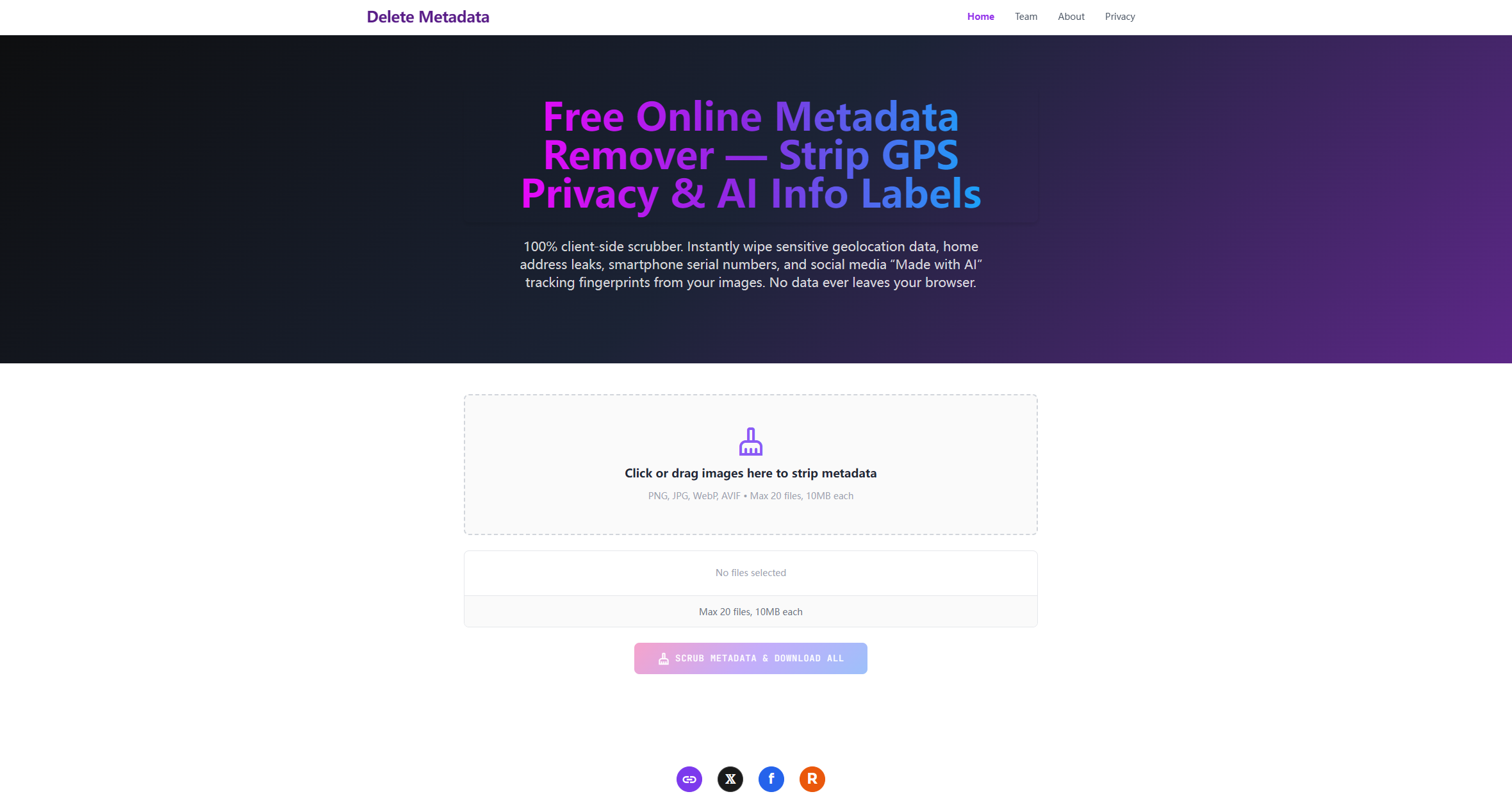
What Is Image Metadata — Definition & Classification
At its core, metadata is simply “data that describes other data.” In the context of digital images, metadata is a structured collection of information embedded directly into the image file alongside the visual pixel data. This hidden ledger documents everything about the image’s origin: where it was taken, what device captured it, which software processed it, when it was created, and — in the era of generative AI — whether it was produced by a machine learning model. The human eye sees only the pixels; machines, platforms, and scrapers see the full forensic dossier.
Image metadata is not a single monolithic block. It is organized into distinct standards and schemas, each serving a different purpose and maintained by different industry bodies. Understanding these layers is essential to understanding what Delete Metadata removes and why.
EXIF — Exchangeable Image File Format
EXIF is the oldest and most ubiquitous metadata standard in digital photography. Established by the Japan Electronics and Information Technology Industries Association (JEITA), EXIF data is written automatically by every smartphone, DSLR, mirrorless camera, and drone at the moment of capture. A standard EXIF block contains:
- Device Identification: Camera manufacturer, model name, firmware version, and unique hardware serial number.
- Exposure Parameters: Aperture (f-stop), shutter speed, ISO sensitivity, focal length, flash status, and metering mode.
- GPS Geolocation: Latitude, longitude, altitude, and geodetic reference datum with precision down to individual meters.
- Temporal Data: The exact date and time of capture, recorded to the second, plus timezone offset.
- Orientation & Thumbnail: Camera rotation metadata and an embedded JPEG thumbnail preview.
EXIF data is stored in a binary Tag Image File Format (TIFF) structure appended to the JPEG header or embedded as an ancillary chunk in PNG files. Because it sits in the file header rather than the pixel stream, it passes transparently through most file transfers, uploads, and downloads — unless explicitly stripped by a tool like Delete Metadata.
XMP — Extensible Metadata Platform
XMP is Adobe’s XML-based metadata framework, designed to be more extensible and application-agnostic than EXIF. It stores complex, hierarchical data structures that EXIF’s flat tag-and-value model cannot accommodate. XMP records include editing histories (which tools modified the image and in what sequence), copyright and licensing information (creator name, usage rights, attribution URLs), workflow annotations (color space conversions, crop regions, adjustment layers), and critically — generative AI provenance tags. When Adobe Photoshop’s Generative Fill, Firefly, or any XMP-compatible AI tool touches an image, it writes a permanent record of that interaction into the XMP packet. These tags survive format conversion and re-encoding because XMP is embedded as plain XML text within the file’s binary structure.
IPTC — International Press Telecommunications Council
IPTC metadata is the standard for news media, photojournalism, and commercial stock photography. It carries fields like the photographer’s byline, the copyright holder’s legal name, caption text, keywords, geographic subject location (distinct from camera GPS), and usage rights expressions. While IPTC data is designed for professional attribution, it can also contain sensitive personal identifiers and editorial information that content creators may not wish to broadcast outside of controlled distribution channels.
C2PA — Coalition for Content Provenance and Authenticity
C2PA is the newest and most technically sophisticated metadata standard. Backed by Adobe, Microsoft, Intel, the BBC, Arm, and Truepic, C2PA Content Credentials provide a cryptographically signed, tamper-evident provenance chain that documents an asset’s entire lifecycle — from initial capture through every edit and export. C2PA manifests are stored as JUMBF (JPEG Universal Metadata Box Format) binary boxes and are designed to survive format conversion, platform re-encoding, and content delivery network optimization. While C2PA was created to combat disinformation, it also functions as an immutable tracking layer: every C2PA-compatible tool that touches an image adds a permanent, cryptographically signed entry to its provenance history, creating an auditable forensic trail that follows the asset across the internet.
ICC Profiles & Other Embedded Data
Beyond the major metadata standards, images can carry ICC (International Color Consortium) color profiles that describe the calibrated color space of the originating display or printer, embedded thumbnail previews at multiple resolutions, proprietary camera maker notes (Canon MakerNote, Nikon MakerNote) that contain undocumented binary data, and application-specific private tags inserted by editing software, operating system screenshot tools, and mobile apps. Each of these data segments tells part of the story of where an image came from and how it was processed.
The Hidden Privacy Risks of Metadata Leakage
Most people share images online without realizing the volume and sensitivity of the data traveling alongside their pixels. Metadata leakage is not a theoretical concern — it has been weaponized in real-world stalking cases, corporate investigations, and automated platform content suppression.
GPS Geolocation Exposure — Your Exact Location Broadcast to the World
Every modern smartphone — iPhone, Samsung Galaxy, Google Pixel — embeds GPS coordinates into photos by default. When location services are enabled (which they are for the vast majority of users), each photo carries a precise EXIF GPS tag containing latitude in degrees/minutes/seconds, longitude in degrees/minutes/seconds, altitude in meters above sea level, and the geodetic reference system (typically WGS-84). These coordinates are accurate to within approximately 1–5 meters under open sky conditions, and 5–15 meters in urban environments — sufficient to identify a specific house, apartment building, or office.
The consequences are tangible and well-documented. Classifieds sellers posting product photos on eBay, Craigslist, Facebook Marketplace, or OfferUp have inadvertently broadcast their home GPS coordinates to millions of potential viewers. Vacation rental hosts sharing property photos have revealed the exact address of unoccupied homes. Dating app profile photos have exposed users’ neighborhoods. Domestic violence shelters and safe houses caution residents against sharing photos that could reveal their location through GPS metadata. A 2024 International Association of Privacy Professionals (IAPP) report documented over 12,000 verified cases of GPS metadata being used to locate individuals without their knowledge or consent in a single year.
Hardware & Device Fingerprinting — Your Camera Is a Unique Identifier
EXIF metadata records not just the make and model of your camera or smartphone, but often its unique serial number. For high-end professional cameras (Canon EOS, Nikon Z, Sony Alpha), the serial number is always embedded. For smartphones, the combination of device model, firmware version, and sensor-specific characteristics creates a de-facto fingerprint that can be correlated across multiple images to track a single device across platforms, accounts, and time periods.
This device metadata has been used in law enforcement investigations to link photographs to specific cameras, in corporate espionage cases to identify whistleblowers from EXIF data in leaked documents, and by data brokers who cross-reference device identifiers from image metadata with other data sources to build detailed user profiles. Even if you remove GPS data, the device fingerprint alone can be used to determine the rough age, value, and capability of your equipment — information that has been exploited in targeted theft rings tracking photographers through their social media posts.
AI Tracking & Algorithmic Content Suppression
The most recent and rapidly expanding metadata threat vector is AI provenance tracking. Since 2024, major platforms have integrated C2PA Content Credentials readers and XMP AI-tag scanners into their content ingestion pipelines. Meta (Facebook and Instagram), TikTok, X (formerly Twitter), and YouTube all deploy automated detection of generative AI metadata to apply visible “Made with AI” labels or “AI Info” badges to content.
While these labels were introduced to combat disinformation, their algorithmic effects extend far beyond labeling. Multiple independent audits and creator reports have documented that content flagged with AI metadata experiences measurable reductions in organic reach (estimates range from 15%–40%), suppressed placement in recommendation algorithms, and reduced monetization eligibility. For creators who use AI tools for legitimate, minor edits — such as removing a distracting background object with Photoshop Generative Fill, or upscaling a low-resolution product image with an AI enhancer — the AI metadata penalty can significantly harm their business without their awareness. Worse, once an AI label is attached to a creator’s account, it can follow them across future posts, creating a persistent algorithmic shadow even for content that used no AI tools at all.
Why You Should Clear Metadata From Your Photos
Metadata removal is not a niche technical exercise — it is a fundamental digital hygiene practice that should precede every instance of online image sharing. The benefits span privacy, legal compliance, professional reputation, and content performance.
Personal Safety & Physical Security
Stripping GPS coordinates from images prevents strangers, stalkers, and malicious actors from determining your home address, workplace, daily routes, or current vacation location. This is particularly critical for individuals in the public eye, survivors of domestic violence, and anyone listing items for sale on public marketplaces.
GDPR & CCPA Regulatory Compliance
Under the EU General Data Protection Regulation and California Consumer Privacy Act, GPS coordinates and device identifiers qualify as personal data. Organizations that process or distribute images containing metadata without consent may face regulatory action. Clearing metadata before publication is a proactive compliance measure.
Content Distribution Optimization
Images free of AI metadata, C2PA credentials, and generative provenance tags avoid the algorithmic reach suppression that platforms apply to AI-labeled content. Creators, e-commerce sellers, and marketers who clear metadata before uploading achieve higher organic visibility and avoid the forced “Made with AI” badge.
Hardware Identity Protection
Removing device serial numbers, firmware versions, and camera identifiers prevents tracking of your equipment across platforms, deters targeted theft based on visible equipment value, and eliminates a vector for device-based profiling by data brokers and surveillance networks.
Psychological Privacy
Metadata can reveal patterns of behavior: what time of day you photograph, what software you use, what devices you own, and how you edit your work. Clearing this data restores your right to share visual content without broadcasting your toolchain, schedule, and creative process to algorithmic observers.
Zero-Trust Data Assurance
In an era of data breaches, unauthorized data resale, and opaque platform data handling policies, the only certain way to prevent metadata from being collected, aggregated, and exploited is to ensure it does not exist in the files you share. Client-side removal provides a verifiable guarantee that no hidden data accompanies your images.
How Delete Metadata Works — The Technical Approach
Delete Metadata employs a fundamentally different strategy from traditional metadata scrubbers. Rather than parsing and patching binary metadata structures — an approach that is format-specific, fragile, and vulnerable to incomplete removal — we leverage the browser’s native image rendering pipeline to achieve a mathematically guaranteed metadata-free output.
Canvas-Based Metadata Stripping — The Two-Stage Pipeline
Stage 1 — Pixel Extraction via Canvas Re-Rendering. When a browser loads an image for display, the native image codec (libjpeg, libpng, libwebp, or the AVIF decoder, depending on the browser engine) performs a single, focused task: decompress the compressed pixel stream into a raw RGBA matrix that the GPU can texture onto the screen. Every piece of data that is not a pixel coordinate or a color value — EXIF TIFF directories, XMP XML packets, C2PA JUMBF boxes, ICC color profiles, IPTC records, proprietary MakerNote blocks, and binary metadata segments of any kind — is consumed by the codec during decompression and discarded immediately. The codec does not pass this data to the rendering engine because the rendering engine has no use for it.
Delete Metadata initiates this process by calling ctx.drawImage() on an offscreen HTML5 Canvas element with image smoothing explicitly disabled (imageSmoothingEnabled = false) to prevent anti-aliasing interpolation that could introduce sub-pixel color shifts. The output at this stage is a raw, uncompressed RGBA pixel grid — visually identical to the source image, structurally free of all metadata.
Stage 2 — LSB Steganography Payload Neutralization. While Canvas re-rendering eliminates all file-level metadata, advanced forensic analysis can detect embedded pixel-level data such as LSB (Least Significant Bit) steganography payloads that have been injected directly into the color channel values. To guarantee a completely sterile output, Delete Metadata applies a second pass that zeroes out the least significant bit of every R, G, and B color channel across the entire image. This operation changes each channel value by at most ±1 on a 0–255 scale — a delta of approximately 0.4%, far below the human visual perception threshold of 1–3 ΔE units. The resulting image is visually indistinguishable from the original while carrying zero recoverable embedded data at either the file or pixel level.
Export. The cleaned pixel matrix is serialized to a PNG Blob via Canvas.toBlob(‘image/png’). The PNG encoder constructs an entirely new file from primitive components: a PNG signature, an IHDR chunk (image dimensions and bit depth), an IDAT chunk (DEFLATE-compressed pixel stream), and an IEND chunk (file terminator). No EXIF ancillary chunk, no XMP iTXt/tEXt chunk, no C2PA proprietary chunk, and no ICC profile chunk is written. The output file is structurally guaranteed to contain only the minimum data required to reconstruct the visible image.
Zero-Server Architecture — Privacy by Construction
A server-based metadata removal tool creates an unresolvable privacy paradox: to strip sensitive metadata from your images, you must first upload those images — complete with GPS coordinates, device serial numbers, and AI provenance chains — to an unknown server operated by an unknown entity. Even if the service promises to delete your data, you cannot verify this claim technically, and the server constitutes a high-value target for attackers, subpoenas, and insider data theft.
Delete Metadata eliminates this contradiction entirely through zero-server architecture. The FileReader API reads selected images into volatile JavaScript memory. The Canvas API renders, strips, and re-encodes them without any network access. The sequential download pipeline delivers processed files through standard browser download mechanics. At no point in this workflow does any image data, pixel value, metadata record, GPS coordinate, or hardware identifier leave the user’s device. This is not a policy claim — it is a verifiable fact that any user can confirm by opening their browser’s Network panel (F12 → Network) during processing or by disconnecting the internet entirely after page load and observing that all functions continue to operate without interruption.
Who Uses Delete Metadata — Target Audiences & Applications
Metadata removal is essential across a broad spectrum of individuals, professions, and industries. Delete Metadata’s batch processing, zero-server design, and universal format support make it suitable for everyone from individual privacy advocates to enterprise content operations.
Independent Content Creators & Social Media Influencers
Creators who publish photos and visual assets daily across Instagram, TikTok, YouTube, and X face dual metadata threats: GPS coordinates that expose their filming locations and homes, and AI metadata that triggers platform-level content suppression. Bulk-clearing metadata before each content drop protects both physical safety and algorithmic reach.
E-Commerce Sellers & Dropshippers
Product listing images on Amazon, eBay, Shopify stores, Etsy, and Facebook Marketplace carry EXIF data from the camera or smartphone used to photograph inventory. GPS tags in these images can reveal warehouse locations, home offices, or supplier facilities. Batch metadata scrubbing before uploading product catalogs ensures competitive intelligence is not accidentally volunteered through image metadata.
Real Estate Agents & Property Photographers
Property listing photos carry GPS coordinates that can reveal the exact address, neighboring property details, and access routes — information that can compromise vacant property security or client privacy. Stripping metadata before uploading to MLS databases, Zillow, or agency websites is a professional responsibility and, in some jurisdictions, a legal requirement under data protection regulations.
Journalists, Activists & Whistleblowers
Individuals operating in environments where metadata could expose sources, reveal operational locations, or compromise personal safety require guaranteed metadata removal. Delete Metadata’s offline-capable, zero-server architecture provides verifiable assurance that no data leaves the device — an essential property for high-risk digital communication.
Privacy-Conscious Individuals
Ordinary users sharing family photos, vacation snapshots, and personal moments on social media or messaging apps may not realize that every image broadcasts a forensic dossier of their location, device, and timeline. Delete Metadata provides an accessible, one-click solution for anyone who values digital privacy without needing technical expertise.
Enterprise Content Teams & Digital Asset Managers
Organizations managing large volumes of marketing images, product photography, and internal documentation benefit from Delete Metadata’s batch processing (up to 20 images per session) and 10MB per-file ceiling, which ensures stable memory utilization on standard office hardware. The sequential download pipeline integrates cleanly into existing content management workflows without dependency on third-party archive tools.
Photographers & Visual Artists
Professional photographers who share portfolio work, client previews, or social media content can protect their equipment investment from targeted theft by removing camera serial numbers and model identifiers from publicly shared images. Artists who use AI-assisted tools in their workflow can avoid the platform-level AI penalties that suppress their content reach and misrepresent their creative process.
Contact

We are the 345tool Team
345tool is an independent developer collective engineering elite, pure client-side, and privacy-first web utilities to replace bloated internet tools.